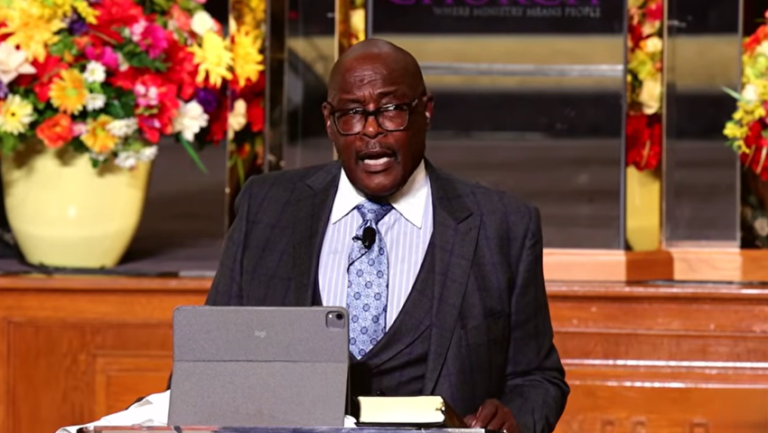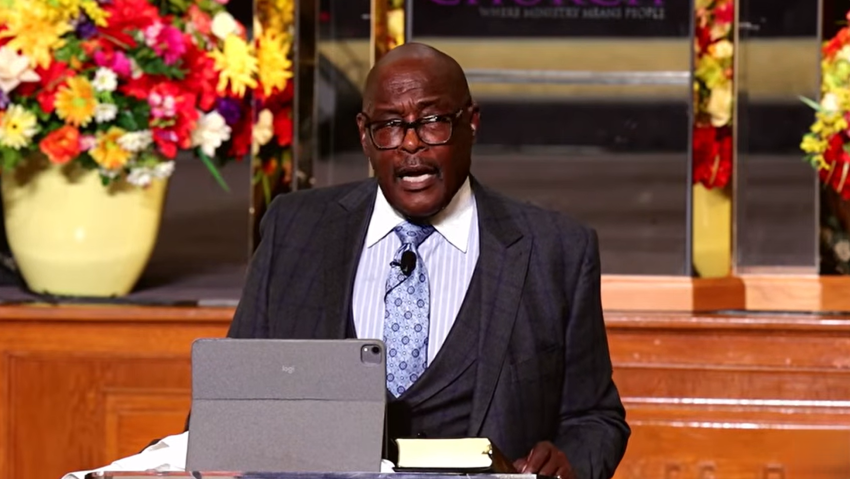
DETROIT — One of gospel music’s most celebrated names is now at the center of a growing financial controversy. Grammy-winning pastor Marvin Winans, senior pastor of Perfecting Church in Detroit, Michigan, is disputing federal tax records that list him as receiving more than $545,000 in a single year from a taxpayer-funded nonprofit organization he leads — insisting he never received “a dime.”
The dispute, first reported by The Center Square and expanded in an investigative follow-up by The Christian Post, has pulled back the curtain on a quarter-century of nonprofit tax filings, an accounting firm that has admitted to errors, and a set of numbers that even those involved struggle to explain.
Who Is Marvin Winans
To understand why this story is sending shockwaves through the Black church community, it helps to know who Marvin Winans is. A member of the legendary Winans family — gospel music royalty — he is a Grammy Award-winning singer whose voice helped define contemporary gospel music. He is also the founder and senior pastor of Perfecting Church in Detroit and president of the Perfecting Community Development Corporation (PCDC), the nonprofit now under scrutiny.
The Report That Started It All
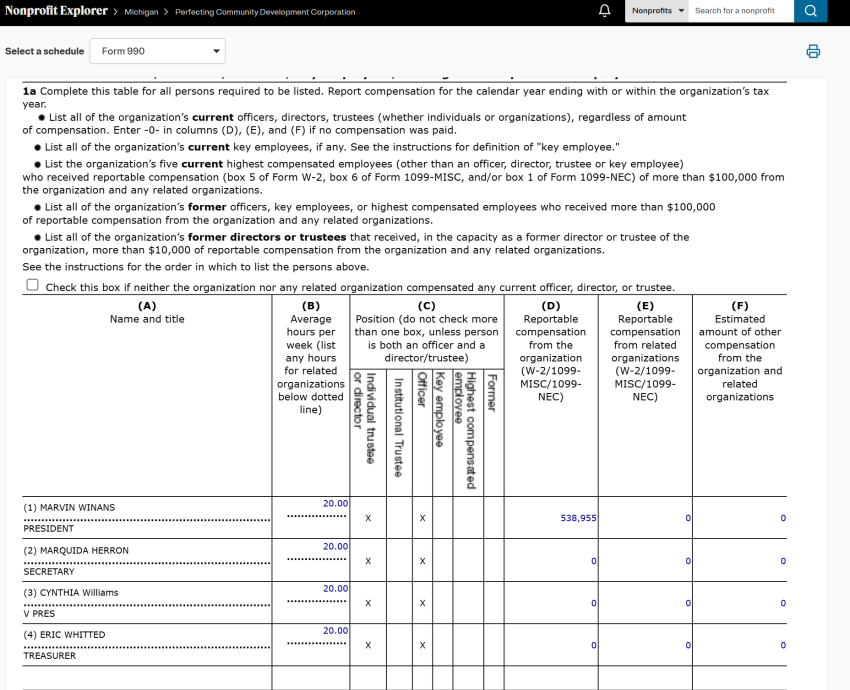
The controversy began when The Center Square published an investigation into PCDC’s finances, based on the organization’s own filings with the Internal Revenue Service. The findings were striking: in 2025, the nonprofit reported paying Winans $538,955 in base compensation for working 20 hours per week — a half-time role that works out to roughly $518 per hour.
To put that figure in perspective, the salary accounted for about 61 percent of everything the nonprofit spent toward its stated mission of “community development” that year. The organization’s total reported revenue for 2025 was $893,898.
The report also noted that Winans’ salary had risen substantially in recent years — and that the increases coincided with a $500,000 state grant to the nonprofit, money that grant guidance indicates came from federal pandemic relief funds. There was another detail that stung: just last year, Winans had publicly admonished a parishioner over what he described as an inadequate donation of $1,235.
What the Tax Filings Actually Show
At the heart of the controversy is the IRS Form 990 — the annual reporting form that most federally tax-exempt organizations must file. It is a public document, designed to let the IRS and the general public evaluate a nonprofit’s operations, including its mission, programs, and finances.
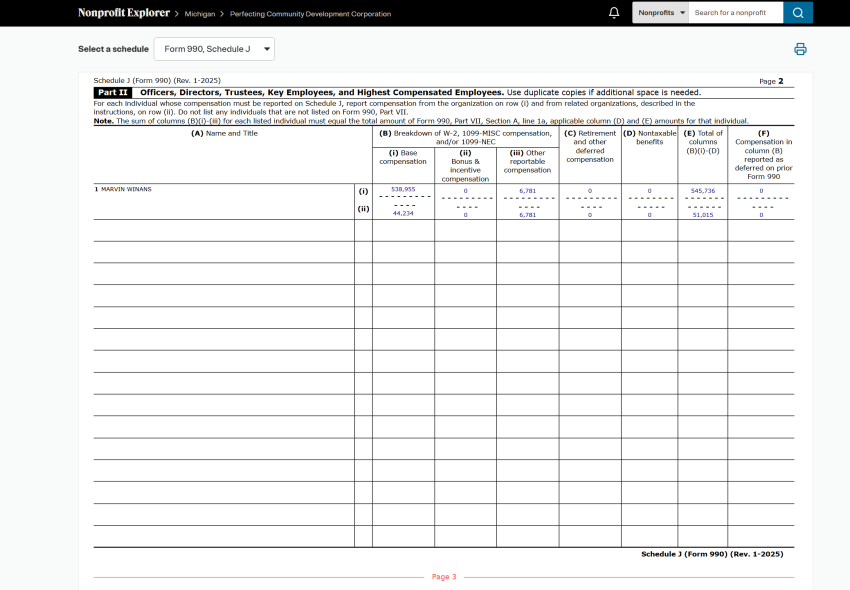
PCDC’s 2025 Form 990, available through ProPublica’s Nonprofit Explorer, lists Winans as the organization’s president, working 20 hours per week. A supplemental document known as Schedule J — which provides detailed disclosures of executive compensation — breaks the numbers down further: $538,955 in base compensation and $6,781 in other reportable compensation, for a total of $545,736.
In 2025, Winans was the only officer on PCDC’s 990 form listed as receiving any compensation at all.
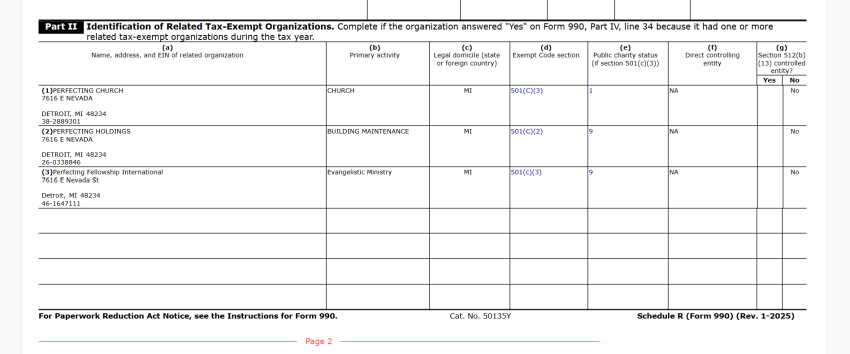
The filing also shows Winans receiving an additional $44,234 in base compensation and $6,781 in other reportable compensation from related organizations, identified in the documents as Perfecting Church, Perfecting Holdings, and Perfecting Fellowship International.
“I Have Never Received a Dime”
Winans responded to the reporting directly, addressing his congregation during a Tuesday night Bible study at Perfecting Church on September 29.
“I can stand here in the holy place and say without thinking, that’s totally a lie. I have never received a dime from Perfecting Community Development Corporation. Not a dime. My name is not on anything,” Winans told his parishioners. “I have to sign it [records] because I’m the president, but I have never, ever received [a dime].”
The pastor placed the blame squarely on the accounting firm that prepares the nonprofit’s filings: Chitwood & Chitwood of Chattanooga, Tennessee, a company that specializes in financial services for ministries and has handled PCDC’s books for 30 years.
“When that came in, we immediately contacted our accountants, which is Chitwood & Chitwood, and they’ve been doing our accounting for the past 30 years. And when looking into it, they found that they had, in fact … made an error and put on PCDC’s tax return that I got paid,” Winans said. “Their firm has admitted guilt, and they’re amending and will refile those returns.”
“I want you to understand, as I stand here in the holy place, I stated unequivocally, I didn’t even have to think about it, I have not taken a dime from Perfecting Community Development Corporation, and that’s one of the reasons why we have been so slow in getting grants ’cause I know there’s a big bullseye on my back,” he maintained.
When contacted, a representative from Chitwood & Chitwood backed the pastor’s account, confirming that Winans never received the money.
A 25-Year Paper Trail
But the story does not end with a single year’s filing. A review of the 990 forms prepared for Perfecting CDC over the last 25 years shows Winans listed as receiving at least $5.5 million in compensation for part-time work across that period.
When pressed, the accounting firm’s representative said, “You’re not looking at the right box,” suggesting the filings do not actually show Winans was paid, and promised records to support this. Asked how the large amounts could be reconciled, the representative offered a new explanation: “They do have employees … 15 of them” — suggesting the figures listed as Winans’ compensation actually represented collective staff compensation.
That explanation runs into trouble with the filings themselves. From 2018 through 2025 — eight consecutive years — the nonprofit reported zero employees, while consistently reporting 15 volunteers. The pattern stretches back further with shifting numbers year to year — 11 employees in 2017, zero in 2016, 13 in 2014–2015, 15 in 2013, 18 in 2010, 27 in 2009, 19 in 2008 — and the firm declined further questions.
Year by Year: The Numbers
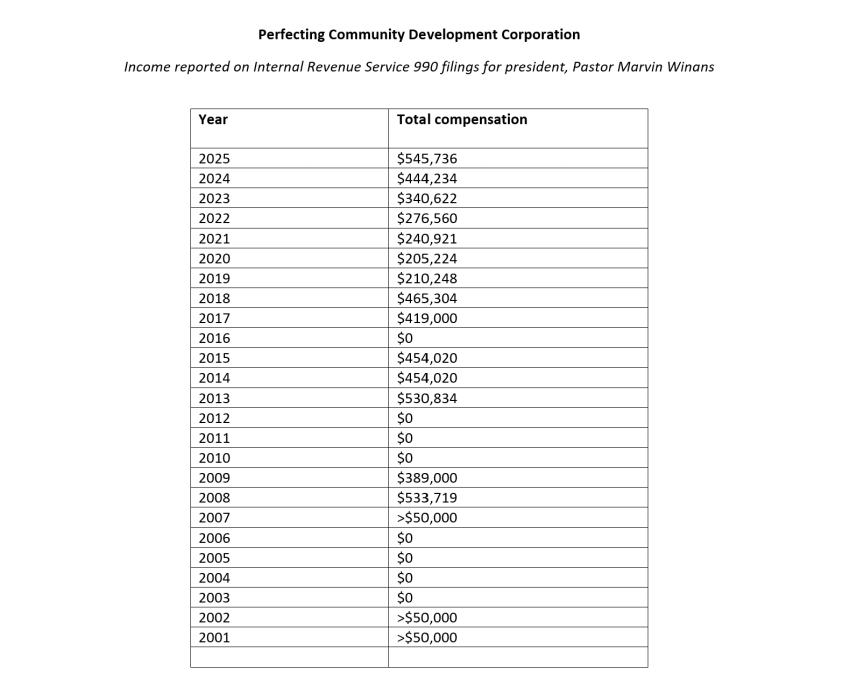
The filings paint a remarkable picture across nearly two decades. In 2024, of $1,050,282 in revenue, Winans was listed as receiving $444,234. In 2023, $340,622 out of $729,119. In 2022, $276,560 out of $740,196. In 2018, of $437,051 in revenue, he was listed at $465,304 total. In 2019: $210,248. In 2020: $205,224. In 2021: $240,921.
In 2013, the filing shows $530,834 in total compensation. In 2014, $454,020. In 2017, $419,000. In 2008, the filing shows $533,719 — and notes that total compensation reported on his prior return was $504,008, a figure inconsistent with the 2007 filing, which stated that no officer received more than $50,000 that year.
Notably, Winans’ claim that he was never compensated is consistent with only eight of the 990 filings over the last 25 years. In the years 2016, 2012, 2011, 2010, 2006, 2005, 2004, and 2003, the filings show him receiving no compensation. In 2001, 2002, and 2007, the filings show no officer receiving more than $50,000.
The People Around the Numbers
The filings also name others in Winans’ orbit. Cynthia Flowers, who served as his vice president, was listed as receiving $102,816 in 2008, $99,216 in 2009, and the same figure in 2010 and 2014.
Kara Black, director of homeless services at the Amelia Agnes Home — the women’s and children’s shelter funded by PCDC — told reporters the compensation figures “is false,” while confirming the shelter is funded by the nonprofit. She could not explain why the 20-bed shelter is not reflected in PCDC’s 990 filing.
Why This Story Matters
Beyond the personalities and the eye-catching figures, the Winans controversy touches a nerve that runs deep through American church life: the question of financial accountability in ministries that operate with public trust and, in cases like this, public money.
Churches themselves are generally not required to report their spending to the federal government — Winans’ salary from Perfecting Church, separate from the nonprofit, is not publicly disclosed. But nonprofits like PCDC are required to file, precisely so the public can see how tax-exempt dollars are used. When the filings themselves become the subject of dispute — with the organization insisting the numbers are wrong and the accountants promising corrections — it leaves donors, congregants, and taxpayers with difficult questions.
For now, the central question remains unresolved. A tax filing records what an organization reported; the presence of a compensation entry does not independently prove a payment reached the person named. At the same time, a denial — even a forceful one made “in the holy place” — does not explain how the entries appeared, why similar entries recur across 25 years, or what the figures were supposed to represent.
What Happens Next
Winans says amended tax returns are being prepared by Chitwood & Chitwood. Until those corrected filings are made public and reviewed, the gap between what the nonprofit told the IRS and what its president says he received will continue to fuel scrutiny — across the church world, in the media, and among the congregants who fill the pews of Perfecting Church each week.
The Gospel Report will continue to follow this developing story.
About the Author