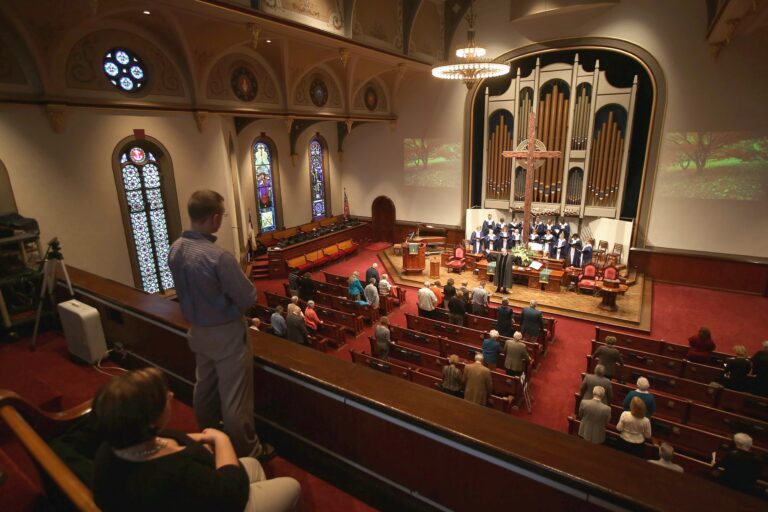
SAN ANTONIO, Texas — As early voting approaches in Texas, one of America’s most prominent megachurches finds itself at the center of two converging election stories. From the pulpit of Cornerstone Church, Pastor Matt Hagee has been delivering an urgent message to his congregation: get registered, show up, and “vote the Bible.” At the same time, voting rights advocates are fighting to strip his church of its status as an official polling location, arguing that its long history of political activism makes it an unfit place for every voter to cast a ballot.
The twin developments have turned the 22,000-member San Antonio megachurch — co-led by Matt Hagee and his father, founder Pastor John Hagee — into a flashpoint in the national debate over the proper distance between the pulpit and the ballot box.
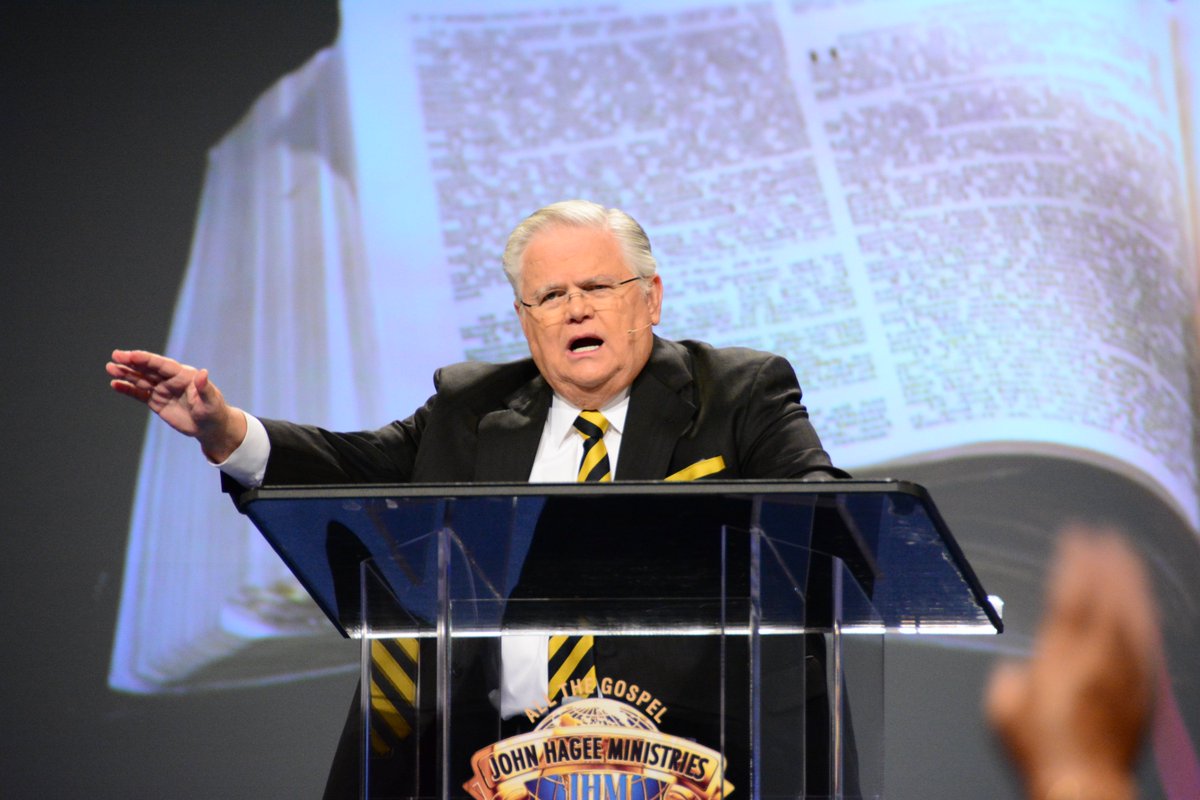
“God’s Enemies Are in Politics”
In a sermon delivered in late September, Matt Hagee left little doubt about where he believes Christians belong in election season.
“Oftentimes when we discuss matters like this in church, people immediately want to say, ‘Why does the church get so political?'” Hagee told the congregation. “As long as God’s enemies are in politics, then God’s people should be in politics.”

During that same sermon, Hagee announced the church’s voter registration portal and told worshippers that the church had “individuals set up in the lobby” to help members check their voter registration status and register to vote.
The message is reinforced everywhere a visitor looks. A September 23 Facebook post from the church featured an image of former President Ronald Reagan alongside stickers reading “Vote the Bible,” linking to a Cornerstone-hosted voter resource page with a registration portal and text-message reminders as Election Day approaches. According to the San Antonio Current, the refrain “Vote the Bible” now appears on a neon sign outside the church complex and on digital screens inside the sanctuary.
The September sermon echoed a similar message from July, when Hagee asked his congregation, “What can I do about a socialist, communist agenda?” — and answered his own question: “Choose this day whom you will serve.”
It also recalled a 22-minute YouTube sermon Hagee posted ahead of the 2024 presidential election, filmed in a darkened room over foreboding music. “Realize this: in less than 90 days the citizens of the United States will make a decision that without question is going to have an impact in the next 90 years,” he said. “As a Christian, I’m not a Republican nor a Democrat — I’m a Bible believer,” he added, before urging viewers to “vote the Bible.” The video’s hashtags, the Current noted, included “#ConservativePolitics,” and fourteen minutes in, Hagee declared that the congregation “simply cannot allow a group of immoral elitists to enslave us in a socialist dictatorship.”
The Polling-Place Battle
While Hagee was mobilizing his congregation, Bexar County officials were deciding where the congregation — and thousands of their neighbors — would vote.
Cornerstone’s sprawling North Side campus, with its 5,000-seat sanctuary, had been selected as both an early voting and Election Day polling location for the November elections. Voting rights advocates say that choice was a mistake.
Valerie Reiffert, executive director of the voting advocacy group Radical Registrars, and local voting rights advocate Kathleen Vale — both members of the Mayor’s Commission on Voting — posted a joint statement on Facebook urging Bexar County to remove Cornerstone from the polling location list, citing the church’s frequent participation in partisan politics.
“Polling places must be neutral, safe, welcoming environments for every voter,” their statement read. “Cornerstone’s history raises legitimate questions about whether it meets that standard. Under Pastor John Hagee’s leadership, Cornerstone has developed a documented record of political activity extending well beyond providing a convenient community facility.”
The advocates raised the issue at a September 24 public meeting of the County Elections Advisory Board. According to their account, Bexar County Elections Administrator Michele Carew listened to the concerns, evaluated the issue, and agreed to remove Cornerstone as a polling location.
But the very next day, Precinct 3 Commissioner Grant Moody — the sole conservative on Bexar County’s Commissioners Court — overruled Carew’s decision, stating that the Commissioners Court had already approved the list of polling locations.
Vale, Reiffert and other advocates are now asking that Cornerstone be struck from the list once again. As an alternative, they proposed the Alzafar Shrine Temple, a Shriners meeting space on North Loop 1604, which they describe as a suitable public facility offering comparable voting access in the same area. They are also demanding transparency about the county’s process and criteria for selecting polling locations.
The History Critics Cite
In their statement, the advocates pointed to a series of political gatherings at Cornerstone over the years that welcomed prominent Republicans, including U.S. Senator John Cornyn and Governor Greg Abbott.
They also recalled 2021, when Cornerstone hosted a far-right political rally at which former Trump National Security Advisor Michael Flynn called for the United States to adopt “one religion.” Viral video from that event, which also featured conspiracy theorists Mike Lindell and Alex Jones, showed attendees chanting “Let’s go, Brandon” — a euphemism for a profane anti-Biden slogan.
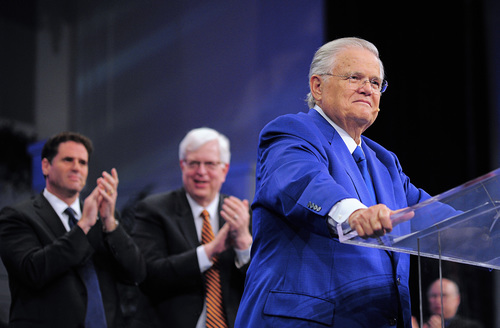
The advocates further cited the record of Cornerstone’s leaders. Founder John Hagee, now 86, established Christians United for Israel (CUFI), one of the largest pro-Israel lobbying groups in the country. He has a long history of controversial statements: in 2008, he called the Catholic Church “the Great Whore” and said that God had arranged the Holocaust to lead to the formation of Israel — a remark for which he later apologized. In June 2025, he posted a video praising President Donald Trump’s military actions involving Iran.
Matt Hagee has his own political footprint. On September 10, 2025, he posted a tribute to conservative commentator Charlie Kirk following Kirk’s assassination, calling him “a bold champion of Truth” who “lived his life as a light to a world filled with evil and darkness.”
At the September 24 meeting, Reiffert spoke in personal terms. “I don’t feel safe going there as a Black woman,” she said, pointing to what she described as a history of racism at the church, including a mock slave auction held at Cornerstone in 1996.
Christine Welde, chair of the Bexar County Democratic Party’s Election Integrity and Voter Protection Committee, echoed the concern about voter comfort. “A polling place should be somewhere every voter — Catholic, LGBTQ+, Muslim, Jewish, nonreligious, Republican, Democrat or independent — can enter without feeling targeted or unwelcome,” she said.
The advocates were careful to note the limits of their argument. “These events do not establish that Cornerstone violated election law. Nor does political participation automatically disqualify a church from serving as a polling location,” their statement read. “But they raise a reasonable question: why should voters be expected to enter a facility so closely associated with partisan political advocacy when alternative neutral public facilities are available in the same geographic area?”
A County Divided on Process
The dispute has also exposed confusion over who actually has the authority to choose — and remove — polling places in Bexar County.
Vale told the Current that Elections Administrator Carew initially claimed she had “no idea” of Cornerstone’s political history because she is “not from San Antonio” and “moved here for the job.” By the end of the September 24 meeting, after looking up the church, Carew said she was not comfortable with Cornerstone hosting a polling place and would remove it, according to the advocates.
Then came Commissioner Moody’s intervention. In an email obtained by the Current, Bexar County Elections Advisory Committee chair Yvonne Pelayo wrote that Moody “emphasized that the list of polling places has already been approved by commissioners court and as such, the location should be utilized as planned.”
It remains unclear whether a single commissioner can veto a removal decision supported by others. The three other commissioners — Tommy Calvert, Justin Rodriguez and Rebeca Clay-Flores — did not respond to the Current’s requests for comment, nor did County Judge Peter Sakai’s office. Neither Carew nor Moody responded either.
Under the Texas Election Code, partisan locations are not expressly forbidden from hosting polling stations; counties are required to “adopt a methodology for determining where each polling place will be located.” Vale told the Current that Bexar County has no such methodology — and noted that polling locations can indeed be removed after approval, pointing to the recent removal of the Bexar County Jail from the polling list at Carew’s discretion.
What Comes Next
With the November elections approaching, the standoff appears unresolved. Cornerstone remains on the polling location list, its “Vote the Bible” signs glowing outside, while advocates continue to press for its removal.

For Matt Hagee, the message from the pulpit is unlikely to soften. His church’s voter resource page remains prominently linked in the top menu of Cornerstone’s website, and the registration portal he announced continues to operate. Through Hagee Ministries’ broadcast arm, Global Evangelism Television, the church claims to reach a vast audience far beyond San Antonio each week.
Whether voters will cast their ballots beneath the steeple of one of America’s most politically outspoken megachurches — or whether the county will find a more neutral home for Precinct 3’s voters — is a question Bexar County officials have yet to finally answer.
The Gospel Report will continue to follow this story as the November elections approach.
About the Author